Join us this June

Help shape the next Massachusetts Strategic Highway Safety Plan

We're holding online and in-person listening sessions next month to help shape the 2027 Massachusetts SHSP. Tell us where you see risks, what's working, and what would make our roads safer for everyone.
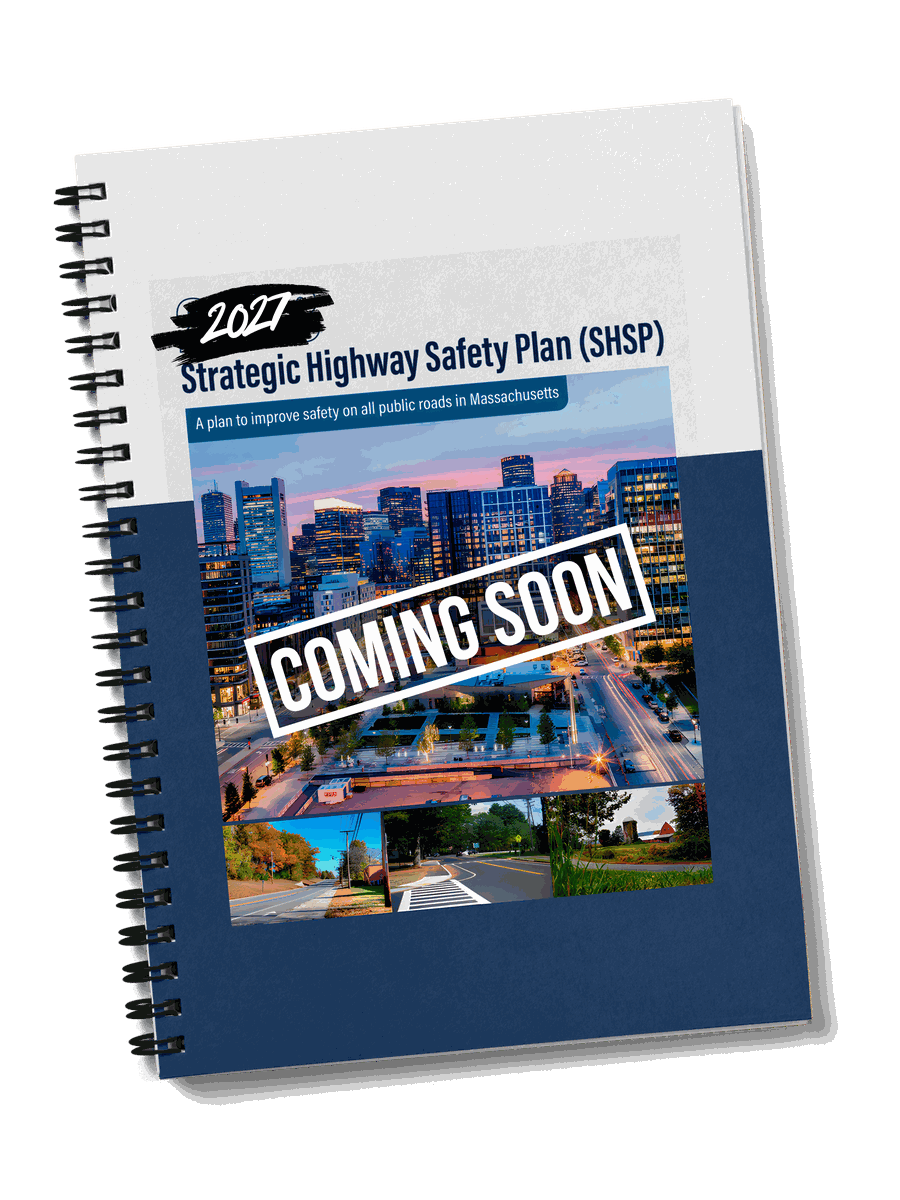
The 2027 Massachusetts Strategic Highway Safety Plan — coming soon

Listening sessions

In person

Tue, June 9, 2026
11:00 AM – 1:00 PM
UMass Charles River Campus
100 Carlson Avenue
Newton, MA 02459

Lunch included with attendance.

Register
Thu, June 11, 2026
12:00 PM – 2:00 PM
UMass Springfield
1500 Main Street, Suite 260
Springfield, MA 01115

Lunch included with attendance.

Register

Online — Zoom webinar

Mon, June 8, 2026
2:00 PM – 3:00 PM
Zoom webinar
Register
Thu, June 18, 2026
11:00 AM – 12:00 PM
Zoom webinar
Register

Questions? Reach out to Michael Knodler at mknodler@umass.edu.

What's in the current plan?

The current (2023) Massachusetts SHSP organizes its work into six initiatives. The 2027 update will build on these — and your input helps shape what comes next.

1 Implement speed management to realize safer speeds
  • 1.1 Evaluate and adjust operating speeds through roadway designs that are self-enforcing, consistent with the new 2022 MassDOT speed management approach.
  • 1.2 Develop and execute a procedure for target speed setting in all project types (e.g., roadway reconstruction, bridge, preservation, development, new roadways).
  • 1.3 Amend Massachusetts regulations related to speed (expand the definition of a school zone, adjust speed-limit setting, modify statutory speeds).
  • 1.4 Enforce state speed laws.
2 Address top-risk locations and populations
  • 2.1 Identify, initiate, and prioritize systemic projects involving top-risk locations.
  • 2.2 Identify, initiate, and prioritize systemic projects involving top-risk populations.
  • 2.3 Biannually update and disseminate information on locations and populations of top risk.
  • 2.4 Evaluate effectiveness.
3 Take an active role to affect change in vehicle design, features, and use
  • 3.1 Identify opportunities for the state to champion safe vehicle designs and features to minimize injury severity, with national, state, and local partners.
4 Accelerate research and adoption of technology
  • 4.1 Pursue research to test new approaches and identify new technologies for improving safety — including methods to screen and curb dangerous behaviors (e.g., drug-impairment levels, testing tools).
  • 4.2 Develop prospective pilots for automated enforcement for red-light running, speed zones, and work zones.
  • 4.3 Expand data linkages to improve our understanding of risks related to serious crashes and opportunities for intervention.
  • 4.4 Evaluate and identify how the roadway safety-related violation structure incentivizes or disincentivizes dangerous driving behavior, and develop recommendations for changes.
  • 4.5 Data management.
5 Double down on what works
  • 5.1 Address top crash locations.
  • 5.2 Expand the use of roadway pilots.
  • 5.3 Expand internal state workforce training to raise awareness about the Safe System approach and educate/train on how to implement it.
  • 5.4 Expand external trainings the state provides to amplify safety, Safe System, and best practices.
  • 5.5 Expand resources to municipalities.
  • 5.6 Get more safety equipment into the hands of road users (e.g., bicycle lights, car seats).
  • 5.7 Expand data-driven targeted enforcement and high-visibility police presence.
  • 5.8 Improve accessibility and linkage of relevant safety-related data to professionals and the public.
  • 5.9 Increase maintenance and operations.
  • 5.10 Increase road safety audits.
  • 5.11 Provide a safe work environment for workers on roadways through increased training, education, awareness of incident management, and cutting-edge approaches.
  • 5.12 Implement proven safety countermeasures in all roadway projects.
  • 5.13 Develop, utilize, and provide guidance resources for effective selection and evaluation of improvements under both state and local jurisdictions.
  • 5.14 Improve post-crash care through better cell-service coverage, new trauma-triage guidelines, more services for those involved in crashes, and increased data linkages.
6 Implement new approaches to public education and awareness
  • 6.1 Develop new approaches, test to find what works, and implement a new type of comprehensive campaign that impacts social norming and behavioral change around speeding, occupant protection, impairment, distraction, and seatbelts.
  • 6.2 Develop an educational opportunity when individuals interact with the Registry of Motor Vehicles (RMV) to renew or obtain a license or ID, so they can learn about safety advances including roadway design, multimodal mobility, signs, and signals.
  • 6.3 Improve driver education and training for those under 18, and expand driver education for parent(s)/guardian(s) of new drivers.
  • 6.4 Improve driver education for new drivers over 18, and provide refreshers for drivers transferring a license from another state.
  • 6.5 Establish a state plan to communicate safety — including how we want media to talk about crashes.

Share an idea

A new Massachusetts SHSP is coming in 2027 — what do you want to see in it? Can't make a session, or just want to add a thought? Tell us your idea for safer Massachusetts roads. Your email is optional and is only used if we need to follow up.